

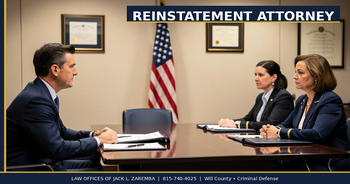
Most people assume the hardest part of getting their Illinois driver's license reinstated is meeting the eligibility requirements — completing treatment, getting their evaluation, paying the fees. They're wrong. The hardest part is the hearing itself, and it catches people off guard because they walk in expecting a simple interview. What they find instead is an adversarial proceeding where the Illinois Secretary of State's office has its own experienced attorney ready to cross-examine every word they say.
If your license has been revoked and you need a formal hearing to get it back, you are walking into a proceeding governed by the Illinois Vehicle Code (625 ILCS 5/6-205, 5/6-208) and the Secretary of State Administrative Rules under 92 Ill. Adm. Code Part 1001. Those rules dictate what evidence is required, what questions will be asked, and what standard of proof you must meet. The burden is entirely on you — the petitioner — to prove you deserve driving relief. The Secretary of State is under no obligation to give it to you, and the state's attorney sitting across the table is specifically tasked with testing whether your case holds up under pressure.
What Actually Happens Inside the Hearing Room
A formal reinstatement hearing is not a conversation. A hearing officer presides over the proceeding while a Secretary of State attorney questions you under oath. Your testimony is recorded. Every document you submit — your alcohol and drug evaluation, treatment records, character letters, driving abstract — is scrutinized for inconsistencies. The state's attorney will compare dates on your evaluation against your arrest history. They will press on gaps in your sobriety timeline. They will ask why you said one thing to your evaluator and something slightly different in your testimony.
In Attorney Zaremba's experience representing clients at the Joliet Secretary of State hearing facility, the single most common reason hearings fail is not ineligibility — it's inconsistency. A client tells the evaluator they had their last drink in 2021 but testifies at the hearing that it was 2020. A treatment completion letter references 12 sessions but the client mentions 10 under questioning. These seem like minor details, but to a hearing officer reviewing your case under 92 Ill. Adm. Code 1001.440, they signal that your account is unreliable. And once credibility is in question, the hearing is effectively over.
What Self-Represented Petitioners Get Wrong
People who attend reinstatement hearings without an attorney for driver's license reinstatement often make the same mistakes. They prepare the documents but not the testimony. They know what their evaluation says but haven't anticipated how the state's attorney will challenge it. They don't realize that hearing officers are trained to identify rehearsed answers that don't match the substance of the underlying records. The Secretary of State's formal hearing process is specifically designed to expose weaknesses in a case, and without preparation, those weaknesses are easy to find.
Another problem is documentation errors that self-represented petitioners don't catch until it's too late. Evaluations that don't meet the Secretary of State's standards under 92 Ill. Adm. Code 1001.410 will not be accepted at the hearing. Treatment records that are incomplete or don't align with the risk classification on the evaluation create contradictions. Character reference letters that use identical language or fail to address the specific criteria the hearing officer needs to see will be given little weight. An experienced driver's license reinstatement attorney identifies and corrects these issues weeks before the hearing date — not at the hearing itself, when it's too late to fix anything.
What a Reinstatement Attorney Actually Does
Hiring a driver's license reinstatement attorney is not about having someone sit next to you at the hearing. The real work happens long before you walk into that room. A reinstatement attorney manages the entire case from the moment you retain them, starting with your driving abstract and working through every document that will be submitted to the Secretary of State.
The process begins with ordering your court purposes driving abstract and reviewing your complete driving history. This record reveals every suspension, revocation, ticket, and DUI disposition on file — and sometimes it reveals old issues that need to be resolved before a hearing can succeed. Unpaid tickets, unresolved failure-to-appear notices, or conflicting records between jurisdictions can derail a reinstatement case before it starts. Your attorney catches these problems early and resolves them.
Next comes the evaluation. As a former Will County prosecutor, Attorney Zaremba understands exactly what the Secretary of State expects to see in an alcohol and drug evaluation, and more importantly, what the state's attorney will attack. He prepares clients before the evaluation to ensure the information they provide is accurate, complete, and consistent with the testimony they will later give at the hearing. This preparation is critical — the evaluation is the foundation of your entire case, and a poorly done evaluation cannot be fixed after the fact. For a detailed look at the steps involved, our Illinois reinstatement process page breaks down the full timeline.
The attorney then reviews all treatment records, secures proper character and abstinence letters, confirms SR-22 insurance or out-of-state waiver requirements are met, files the formal hearing request and $50 filing fee with the Secretary of State, and conducts detailed testimony preparation sessions with the client. Those sessions cover every question the hearing officer and state's attorney are likely to ask — and there are well over 100 of them. The goal is not to script answers but to ensure the client can respond truthfully and consistently under cross-examination without contradicting any document in the record.
The Difference Preparation Makes
One pattern Attorney Zaremba sees repeatedly is clients who come to his office after being denied at a previous hearing where they represented themselves. They completed the right treatment. They had a valid evaluation. They were genuinely eligible for driving relief. But they lost because their testimony didn't hold up under the state's attorney's questioning, or because a documentation error they didn't recognize gave the hearing officer a reason to deny the petition. A denial means waiting months before reapplying, during which the client still cannot drive legally — and if they're caught driving on a revoked license, they face Class A misdemeanor charges under 625 ILCS 5/6-303 with penalties up to one year in jail and $2,500 in fines.
The stakes of walking into that hearing room unprepared extend far beyond the hearing itself. A denial creates a record with the Secretary of State that carries into future hearings. Anything you said under oath at a failed hearing can be compared against what you say at the next one, and any inconsistency between the two becomes another credibility problem to overcome. The most efficient path to getting your license back is getting it right the first time, and that almost always means having experienced legal representation. We've helped hundreds of clients through this process — see our recent case results for examples of successful reinstatements after DUI revocations, multiple offenses, and out-of-state holds.
If you need a driver's license reinstatement attorney for an Illinois Secretary of State hearing, contact the Law Office of Jack L. Zaremba for a free consultation. Our office is located steps from the Joliet SOS hearing facility at 54 North Ottawa Street, and we handle hearings via WebEx for clients who live out of state. Visit our contact page or call 815-740-4025.